
For athletes, an injury is more than a temporary inconvenience. Whether you are a professional competitor, weekend runner, high school athlete, or someone who simply wants to stay active, an injury can interfere with training, competition, work, and everyday life.
When traditional treatments do not provide the relief or recovery you need, you may begin hearing about platelet-rich plasma (PRP) injections for athletes. PRP has become increasingly popular in sports medicine as physicians look for ways to support the body’s natural healing processes and help athletes manage certain orthopedic and musculoskeletal injuries.
But what exactly is PRP? Does PRP work for sports injuries? Which injuries may benefit from PRP injections, and how long does it take to return to sports after treatment?
At Barbour Orthopaedics & Spine, we believe athletes deserve answers based on their individual injury, goals, and the best available medical evidence—not one-size-fits-all treatment recommendations.
What Is PRP?
Platelet-rich plasma, or PRP, is a concentrated preparation made from a patient’s own blood.
During a PRP procedure, a small amount of blood is drawn and processed to separate and concentrate platelets within the plasma. The resulting PRP preparation is then injected into or around the injured area, depending on the condition being treated.
Platelets are best known for their role in blood clotting. However, they also contain signaling proteins and growth factors involved in the body’s normal response to tissue injury.
The goal of PRP treatment is not simply to “put new tissue” into an injured area. Instead, PRP is intended to modify the local healing environment and potentially support the body’s natural repair processes.
PRP preparations are not all identical. The concentration of platelets, presence of other blood components, processing methods, and injection technique can vary. This variability is one reason why research on PRP has produced different results for different injuries.
In other words, PRP is a treatment approach—not a single standardized medication.

That distinction is particularly important for athletes considering PRP for sports injuries.
Why Are Athletes Interested in PRP?
Athletes place significant demands on their muscles, tendons, ligaments, and joints. Repetitive loading, sudden changes in direction, collisions, overuse, and high training volumes can all contribute to injury.
For some injuries, rest, activity modification, physical therapy, medications, or other conservative treatments may be enough. For others, symptoms can persist despite appropriate treatment.
Some athletes are also interested in PRP because they want to avoid or delay surgery when appropriate. However, PRP should not be viewed as a universal alternative to surgery. Some injuries require surgical repair, and delaying appropriate treatment can sometimes make recovery more difficult.
The most appropriate treatment depends on the type and severity of the injury, how long symptoms have been present, the athlete’s goals, and other individual factors.
What Sports Injuries Can PRP Treat?
PRP has been studied for a wide variety of orthopedic and sports-related conditions. However, the quality and strength of evidence varies considerably depending on the injury.
Potential applications may include certain:
- Tendon injuries and tendinopathies
- Muscle injuries
- Ligament injuries
- Joint conditions
- Cartilage-related injuries
- Overuse injuries
- Chronic musculoskeletal pain
Examples of conditions in which PRP has been investigated include Achilles tendinopathy, patellar tendinopathy, tennis elbow, plantar fasciitis, and certain muscle injuries.
Importantly, research does not show that PRP works equally well for all of these conditions. An umbrella review examining systematic reviews of PRP for sports-related muscle, tendon, and ligament injuries found that evidence was inconsistent, with many studies limited by differences in PRP preparation, treatment protocols, comparison treatments, and study design.
That is why a sports medicine physician should evaluate the underlying injury before recommending PRP.
PRP for Tendon Injuries
Tendons connect muscles to bones and are exposed to substantial forces during athletic activity.
Tendon problems can develop gradually through repetitive loading or occur after an acute injury. Common examples include Achilles tendinopathy, patellar tendinopathy, and lateral elbow tendinopathy.
PRP has been studied extensively for several types of tendinopathy. Some studies have found improvements in pain and function, while others have found little or no meaningful difference compared with other treatments.
The evidence is therefore not a simple “PRP works” or “PRP doesn’t work.”
A 2026 international expert consensus specifically addressing rehabilitation and return to activity after PRP for chronic tendinopathies emphasized the importance of structured rehabilitation following the injection. The experts reached agreement on several rehabilitation and follow-up principles, although they also noted that the evidence supporting many recommendations remains limited.
This highlights an important point for athletes:
PRP should generally be viewed as part of a comprehensive treatment plan rather than a standalone solution.
PRP for Muscle Injuries
Muscle injuries are common in athletes, particularly in sports involving sprinting, jumping, cutting, and explosive movements.
Hamstring injuries are a familiar example. Athletes may be tempted to return as quickly as possible once pain improves, but returning before the muscle has adequately recovered can increase the risk of reinjury.
PRP has been investigated as a potential treatment for acute muscle injuries, including hamstring injuries. The research has historically been inconsistent.
More recent research provides an interesting perspective. A 2026 systematic review and meta-analysis of systematic reviews found that PRP was associated with a lower risk of reinjury following acute muscle injuries. However, the evidence did not demonstrate a statistically significant reduction in return-to-sport time, and uncertainty remains around some outcomes, including short-term pain relief.
Another 2026 systematic review of randomized controlled trials evaluated PRP and return to sport in athletes with acute muscle injuries. The authors reported evidence suggesting PRP may accelerate return to sport in some circumstances, but they also highlighted concerns about statistical fragility and variability among studies.
The takeaway is important: PRP may have a role for selected muscle injuries, but it should not be promoted as a guaranteed shortcut to getting back on the field.
PRP for Ligament Injuries
Ligaments connect bones and provide stability to joints. Athletic ligament injuries can range from mild sprains to significant tears.
PRP has been investigated for a number of ligament-related injuries, but the evidence varies depending on the specific ligament, severity of injury, treatment technique, and whether PRP is being used alone or in conjunction with another treatment.
For some injuries, structured rehabilitation may be the primary treatment. For others, surgery may be necessary to restore stability or function.
A thorough orthopedic evaluation is therefore particularly important before deciding whether PRP is appropriate.
Can PRP Help Athletes Avoid Surgery?
This is one of the most common questions athletes ask.
The answer is: sometimes, but PRP is not a replacement for surgery in every situation.
Certain orthopedic injuries can be successfully managed without surgery. In those cases, PRP may be considered as one component of a nonsurgical treatment plan.
However, some injuries involve structural damage that cannot reasonably be addressed with an injection alone. Significant ligament tears, unstable injuries, certain tendon ruptures, displaced fractures, and other serious orthopedic conditions may require surgical treatment.
A PRP injection should never be used simply to postpone necessary care.
The right question is not, “Can PRP keep me out of surgery?”
A better question is:
“Based on my specific injury, what treatment gives me the best opportunity for a safe and successful recovery?”
That is the conversation an experienced orthopedic or sports medicine specialist should have with you.
What Happens During a PRP Injection?
A PRP procedure is generally performed in an outpatient setting.
Although techniques vary, the process typically involves several steps.
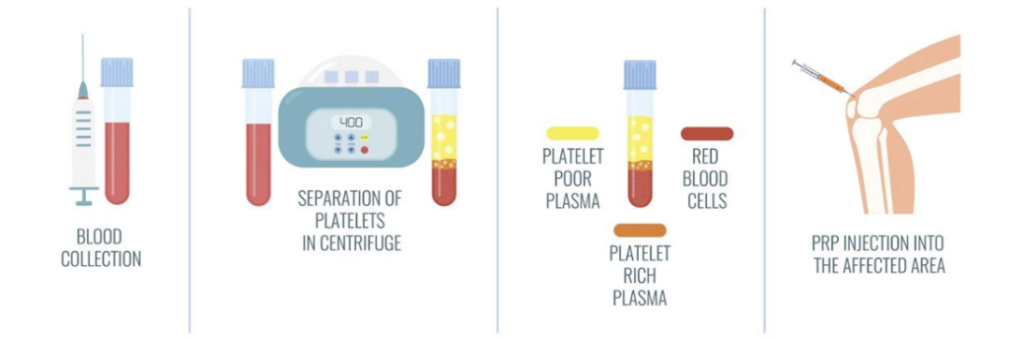
1. Evaluation
Before treatment, your physician will evaluate your symptoms, medical history, activity level, and injury. Imaging such as X-rays, ultrasound, or MRI may be used when appropriate to better understand the affected tissue.
The goal is to confirm that PRP is being considered for the right diagnosis.
2. Blood Draw
A small amount of your blood is collected.
3. Blood Processing
The blood is placed into a specialized system designed to separate its components and concentrate the platelets within the plasma.
4. Injection
The resulting PRP is injected into the targeted area.
Depending on the injury, your physician may use imaging guidance to help accurately target the affected tissue.
5. Recovery and Rehabilitation
After the injection, your physician will provide instructions regarding activity, medications, physical therapy, and follow-up.
This final step is critical.
The injection itself is only one part of the treatment process.
Does PRP Hurt?
Patients often wonder whether PRP injections are painful.
Some discomfort can occur during and after the procedure. Because PRP is injected into an injured or irritated area, patients may experience temporary soreness afterward.
Your physician will provide specific instructions for managing discomfort following treatment.
Post-procedure recommendations can vary based on the injury and treatment plan. Athletes should follow their physician’s instructions rather than attempting to accelerate recovery on their own.
How Long Does PRP Take to Work?
There is no universal PRP recovery timeline.
Some patients may notice improvement relatively quickly, while others may require several weeks or longer before experiencing meaningful changes.
The timeline depends on several factors, including:
- The type of injury
- Whether the injury is acute or chronic
- The location and severity of the injury
- The athlete’s overall health
- Training demands
- Rehabilitation
- The specific PRP preparation and treatment protocol
It is important to understand that PRP is not comparable to an injection designed simply to numb pain.
The goal is to influence the healing environment, so improvement may occur gradually.
How Soon Can You Return to Sports After PRP?
One of the biggest misconceptions about PRP for athletes is that receiving an injection automatically means a rapid return to competition.
It does not.
Return to sport should be based on recovery and function—not simply the number of days since the injection.
Depending on the injury, your treatment plan may include a period of relative rest followed by progressively increasing activity.
Rehabilitation may focus on:
- Reducing irritation and allowing the treated tissue to recover
- Restoring range of motion
- Improving strength
- Correcting movement patterns
- Gradually increasing sport-specific loading
- Testing functional performance
- Returning to practice
- Progressing toward full competition
A 2026 international consensus on rehabilitation after PRP for chronic tendinopathies emphasized structured rehabilitation, follow-up, and individualized progression back to activity.
For competitive athletes, the final decision to return should consider not only whether pain has improved, but also whether strength, mobility, coordination, endurance, and sport-specific function have adequately recovered.
PRP and Physical Therapy: Why Both Matter
PRP and physical therapy are sometimes presented as competing treatments.
In many cases, they are better understood as complementary components of a larger recovery strategy.
Physical therapy can help address the mechanical and functional factors that contributed to an injury in the first place.
Depending on the diagnosis, rehabilitation may focus on:
- Strengthening the injured tissue
- Improving flexibility and mobility
- Restoring joint mechanics
- Improving balance and stability
- Correcting movement patterns
- Gradually increasing tissue load
- Preparing the athlete for sport-specific demands
An injection cannot replace the work required to rebuild strength and function.
For athletes, this is especially important because returning to a high level of activity requires more than simply becoming pain-free.
Is PRP Safe?
Because PRP is created from a patient’s own blood, it is considered an autologous treatment.
As with any injection, however, PRP has potential risks. These can include temporary pain or soreness, bleeding, infection, nerve or tissue injury, and other complications associated with injections.
Your physician should discuss the potential risks and benefits with you before treatment.
The safety and effectiveness of PRP can also depend on how and where it is administered. That makes proper diagnosis and appropriate injection technique important considerations.
Why Doesn’t PRP Work for Everyone?
There is no single PRP treatment protocol that works for every athlete or every injury.
Research studies have used different:
- Platelet concentrations
- PRP formulations
- Processing systems
- Injection volumes
- Number of injections
- Treatment intervals
- Injection techniques
- Rehabilitation protocols
These differences make it difficult to compare results across studies.
Experts have also noted that standardization of PRP preparation and treatment protocols remains an important need in research.
This is one reason an individualized approach is so important.
A treatment that may be reasonable for one athlete’s chronic tendon problem may not be appropriate for another athlete with an acute muscle tear.
PRP vs. Cortisone Injections
Athletes may also wonder how PRP compares with corticosteroid, or cortisone, injections.
These treatments have different purposes.
Corticosteroids are anti-inflammatory medications that may provide relatively rapid symptom relief for certain conditions. PRP is intended to influence the local biological environment and support tissue healing.
Neither treatment is automatically better.
The appropriate option depends on the diagnosis, goals, timing, and overall treatment plan.
Your orthopedic specialist can help you understand which treatment is appropriate for your specific condition.
PRP vs. Surgery
PRP and surgery should not be thought of as interchangeable treatments.
Surgery may be necessary when an injury causes significant structural damage or when nonsurgical treatment has failed and the patient’s condition warrants an operation.
PRP may be considered when nonsurgical treatment is appropriate and the patient’s specific condition is one for which PRP may offer potential benefit.
The goal is not to choose the least invasive treatment at all costs.
The goal is to choose the right treatment for the injury and the athlete.
What Does the Research Say About PRP for Athletes?
The research surrounding PRP is evolving.
Earlier reviews found inconsistent results and generally low or very low certainty of evidence for many sports-related injuries.
More recent research has continued to produce nuanced findings.
For example, newer evidence suggests that PRP may reduce reinjury rates in some acute muscle injuries, while evidence regarding faster return to sport and pain relief remains less certain.
This is an important distinction.
Good sports medicine is not about promising that every treatment will work. It is about determining when a treatment is appropriate and using it as part of an evidence-informed plan.
At Barbour Orthopaedics & Spine, treatment decisions should be based on the individual athlete rather than on the popularity of a particular procedure.
Who May Be a Candidate for PRP?
You may be considered for PRP if you have a musculoskeletal injury that:
- Has been accurately diagnosed
- Is appropriate for nonsurgical treatment
- Has not adequately improved with other conservative care
- Is one for which PRP may reasonably be considered
- Fits your personal activity and recovery goals
PRP may be particularly worth discussing if you are an athlete dealing with a persistent tendon problem, selected muscle injury, or another condition for which your physician believes biologic treatment may have a role.
However, not every athlete is a candidate.
The best way to determine whether PRP makes sense is to have your injury evaluated by an orthopedic or sports medicine specialist at Barbour Orthopaedics & Spine.
The Bottom Line on PRP Injections for Athletes
PRP injections may be a useful treatment option for selected sports injuries, but they are not a cure-all and they are not a guaranteed shortcut to recovery.
Research suggests that PRP may provide benefits for certain tendon, muscle, and other musculoskeletal conditions, but results vary significantly by injury and treatment protocol. Recent evidence is encouraging in some areas, particularly regarding reinjury following certain acute muscle injuries, while questions remain about pain relief, return-to-sport timing, and which patients benefit most.
For athletes considering PRP, the most important step is not deciding whether PRP is “good” or “bad.”
It is determining whether PRP is appropriate for your injury, your body, and your goals.
At Barbour Orthopaedics & Spine, our orthopedic specialists take an individualized approach to sports injuries and musculoskeletal conditions. Whether your goal is returning to professional competition, getting back to your favorite recreational activity, or simply moving without pain, our team can help you understand your options and develop a treatment plan based on your diagnosis and goals.
Don’t let an injury determine what you can do next.
If you’re an athlete dealing with a persistent sports injury and wondering whether PRP may be right for you, schedule an evaluation with Barbour Orthopaedics & Spine to discuss your treatment options.
Follow us on our social media!

1 Comment
Hi there to all, for the reason that I am genuinely keen of reading this website’s post to be updated on a regular basis. It carries pleasant stuff.
Comments are closed.