
When joint pain lingers for weeks or months despite rest, medication, and home remedies, something deeper is often going on beneath the surface. At Barbour Orthopaedics & Spine, we see patients every day who have been living with chronic joint pain far longer than necessary, often because they never received the advanced imaging needed to pinpoint the true source of their discomfort. A joint pain MRI or other form of orthopedic imaging can be the turning point that transforms a frustrating cycle of guesswork into a clear, actionable treatment plan.
This comprehensive guide explains when imaging becomes essential for chronic joint pain, what each type of imaging reveals, and how getting the right scan at the right time can change your path to recovery.
Common Causes of Chronic Joint Pain
Chronic joint pain is defined as discomfort that persists for more than several weeks and interferes with your daily activities, sleep, or ability to stay active. While occasional soreness after heavy activity is normal, pain that does not resolve with standard conservative measures often signals an underlying structural or degenerative condition that requires further investigation through orthopedic imaging.
Arthritis and Degenerative Joint Disease
Osteoarthritis is one of the most common causes of persistent joint pain, particularly in the knees, hips, shoulders, and hands. This degenerative condition occurs when the protective cartilage cushioning the ends of bones gradually wears down, leading to pain, stiffness, and reduced mobility. According to research published in Osteoarthritis and Cartilage, osteoarthritis affects approximately 15 percent of the population and is the leading cause of lower extremity disability among older adults. Rheumatoid arthritis, an autoimmune condition, can also cause chronic inflammation in multiple joints and may lead to irreversible damage if not diagnosed and treated early.
Ligament Tears
Torn ligaments, such as the anterior cruciate ligament (ACL) in the knee or the ligaments of the ankle and shoulder, often produce persistent pain, instability, and swelling. These soft tissue injuries are frequently invisible on standard X-rays, making a joint pain MRI essential for accurate diagnosis. Untreated ligament injuries can lead to chronic instability and accelerate the development of arthritis in the affected joint.
Cartilage Damage
Articular cartilage damage and meniscal tears in the knee are extremely common sources of chronic joint pain. A torn meniscus, for example, may cause clicking, locking, and persistent swelling that does not improve with rest alone. Advanced imaging is often the only reliable way to detect cartilage injuries, since these structures are not visible on conventional X-rays.
Tendon Injuries
Chronic tendon conditions, including tendinitis, tendinosis, and partial tendon tears, affect the shoulder (rotator cuff), elbow (tennis elbow), hip, knee (patellar tendon), and Achilles tendon. These injuries cause ongoing pain that often worsens with activity and may not respond to standard anti-inflammatory treatment without proper identification of the extent of damage.
Labral Tears
The labrum is a ring of cartilage that deepens the socket of the hip and shoulder joints, providing stability and cushioning. Labral tears can cause deep, aching pain, catching sensations, and limited range of motion. These injuries are notoriously difficult to diagnose without MRI, as physical examination alone cannot confirm the diagnosis in many cases.
Stress Fractures
Stress fractures are tiny cracks in bone caused by repetitive force or overuse. They commonly occur in the feet, shins, and hips, especially in runners and athletes. Early stress fractures may not appear on standard X-rays for several weeks after symptoms begin, making MRI the preferred tool for early detection and preventing progression to a complete fracture.
Warning Signs That Imaging Is Needed
Not every instance of joint discomfort requires advanced imaging. However, there are clear warning signs that indicate it is time to move beyond rest and over-the-counter remedies and pursue orthopedic imaging for a definitive diagnosis.
You should consider advanced imaging evaluation if you experience any of the following:
Pain lasting more than four to six weeks that has not improved with rest, ice, compression, and elevation or basic anti-inflammatory medications.
Joint swelling that does not resolve, particularly if it recurs after activity or appears without obvious cause.
Mechanical symptoms such as clicking, locking, catching, or a sensation that the joint is giving way, which may indicate a cartilage or ligament injury.
Pain that disrupts sleep or daily activities, preventing you from walking, climbing stairs, exercising, or performing work-related tasks.
Limited range of motion that is progressively worsening or not responding to physical therapy.
A history of injury followed by persistent symptoms, even if the initial injury seemed minor.
Pain accompanied by numbness, tingling, or weakness in the affected limb, which may suggest nerve involvement.
When these warning signs are present, a thorough evaluation that includes appropriate imaging helps your orthopedic specialist identify the exact cause of your pain and develop an effective treatment plan without further delay.
Understanding Orthopedic Imaging: X-Ray, MRI, CT Scan, and Ultrasound
Modern orthopedic medicine relies on multiple imaging modalities, each offering distinct advantages depending on the suspected condition. Understanding the differences between these tools helps you appreciate why your doctor may recommend one type of scan over another.
| Imaging Type | How It Works | Best For | Limitations |
|---|---|---|---|
| X-Ray | Uses small amounts of radiation to capture images of bones and dense tissues | Fractures, dislocations, bone spurs, advanced arthritis, joint alignment | Cannot visualize soft tissues like ligaments, tendons, cartilage, or early-stage arthritis |
| MRI | Uses magnetic fields and radio waves to produce detailed cross-sectional images | Soft tissue injuries (ligaments, tendons, cartilage, labrum), bone marrow edema, early arthritis, stress fractures | Longer scan time, higher cost, requires patient to remain still |
| CT Scan | Uses rotating X-rays and computer processing to create cross-sectional images | Complex fractures, bone detail for surgical planning, joint replacement assessment | Involves radiation exposure, limited soft tissue contrast compared to MRI |
| Ultrasound | Uses high-frequency sound waves to create real-time images | Tendon injuries, joint inflammation, fluid accumulation, guided injections | Operator-dependent, limited ability to image deep joint structures and bone |
X-Ray: The Essential First Step
X-rays remain the most widely used initial imaging study for joint pain evaluation. They are fast, widely available, and cost-effective. X-rays can reveal fractures, dislocations, bone spurs, joint space narrowing associated with arthritis, and skeletal alignment issues. For patients with persistent joint pain, X-rays are often instrumental in identifying or ruling out bony causes of discomfort. However, it is important to understand their limitations. As noted by orthopedic imaging specialists, soft tissue injuries like muscle tears or ligament sprains are not detectable with X-rays, which means that a normal X-ray does not necessarily mean there is nothing wrong with your joint.
MRI: The Gold Standard for Soft Tissue Evaluation
Magnetic resonance imaging is one of the most powerful diagnostic tools available for evaluating chronic joint pain. Unlike X-rays, an MRI uses magnetic fields and radio waves rather than radiation to produce highly detailed images of soft tissues, including cartilage, ligaments, tendons, muscles, and bone marrow. A joint pain MRI can reveal conditions that standard X-rays simply cannot detect, including ligament tears, meniscal damage, labral tears, tendon injuries, bone marrow edema, early cartilage degeneration, and subtle stress fractures.
Research from the Hospital for Special Surgery highlights that MRI is very sensitive imaging that can reveal subtle changes in bony and soft tissues, including inflammation, degenerated cartilage, and fluid accumulation in the bone marrow. This level of detail is especially valuable when symptoms of osteoarthritis or other joint conditions arise before degeneration is visible on standard X-rays, which is why orthopedic specialists frequently order MRI when X-ray findings do not fully explain a patient’s symptoms.
CT Scan: Detailed Bone Imaging
Computed tomography scans combine X-ray technology with advanced computer processing to generate detailed cross-sectional images of joints. CT scans provide excellent visualization of bone structures, making them particularly valuable for assessing complex fractures, evaluating bone detail prior to surgical planning, and monitoring certain post-surgical conditions. CT scans are also faster to perform than MRI, with a typical scan taking only a few minutes compared to 30 minutes or more for an MRI.
Ultrasound: Real-Time Dynamic Imaging
Musculoskeletal ultrasound uses high-frequency sound waves to produce real-time images of soft tissues surrounding joints. One of the unique advantages of ultrasound is its dynamic capability, allowing your provider to move the joint during the examination and observe structures in motion. Ultrasound is particularly useful for assessing tendon injuries, detecting joint inflammation and excess fluid, and guiding needle placement during therapeutic injections. It is also radiation-free and widely accessible.
How a Joint Pain MRI Detects What X-Rays Miss
One of the most important things for patients to understand about chronic joint pain is that a normal X-ray does not rule out a significant injury. Many of the most common causes of persistent joint discomfort involve soft tissue structures that are invisible on standard radiographs.
A joint pain MRI can differentiate between fat, water, and muscle tissue, producing multi-angle images that give your orthopedic specialist a complete picture of the joint from the inside. MRI is best at evaluating joint abnormalities including torn cartilage, damaged tendons, and injured ligaments. It also excels at detecting bone marrow edema, an early indicator of stress reactions and bone injury that frequently precedes visible fractures on X-ray.
Consider a common clinical scenario: a patient presents with persistent knee pain after a twisting injury. An X-ray shows no fracture and only mild joint space narrowing. Without further imaging, this patient might be diagnosed with mild arthritis and sent home with anti-inflammatory medication. However, a joint pain MRI might reveal a torn meniscus, a partial ACL tear, or early cartilage damage that completely changes the treatment approach. Research published in the British Medical Journal Open Sport and Exercise Medicine confirms that MRI can be used to gain more information about the joint than is obtainable from radiographs alone, helping eliminate other diagnoses and providing a more detailed picture of chondral surfaces and bone changes.
This is precisely why orthopedic imaging with MRI is so critical for patients whose pain persists despite initial treatment. The scan provides the missing piece of the diagnostic puzzle that allows for targeted, effective intervention.
Why Early Orthopedic Imaging Prevents Delayed Diagnosis
Delaying advanced imaging when chronic joint pain is present can have real consequences for your health and recovery. When a structural injury or degenerative condition goes undiagnosed, patients often continue activities that aggravate the problem, leading to worsened damage, increased pain, and a longer road to recovery.
Conditions like herniated discs, torn ligaments, or arthritis may not cause significant pain initially, but over time, they can progress and become more difficult to treat. The risks of delaying an MRI include inaccurate diagnoses based on symptoms alone, prolonged recovery times, and in some cases, permanent damage to joints, muscles, or tendons. Studies consistently show that early diagnosis leads to earlier initiation of targeted treatment, which improves both short-term and long-term outcomes.
For example, a labral tear in the hip that is identified early can often be managed with targeted physical therapy and activity modification. If that same tear goes undetected for months or years, the resulting instability can accelerate cartilage wear and eventually lead to advanced arthritis requiring joint replacement. Similarly, an untreated ligament injury in the knee can lead to progressive osteoarthritis. Research shows that 10 to 20 years following an ACL rupture, up to 50 percent of patients develop knee osteoarthritis, underscoring the importance of early detection and management.
Early orthopedic imaging breaks the cycle of uncertainty, misdiagnosis, and ineffective treatment that many patients with chronic joint pain experience.
Convenient, Patient-Centered MRI at Barbour Orthopaedics
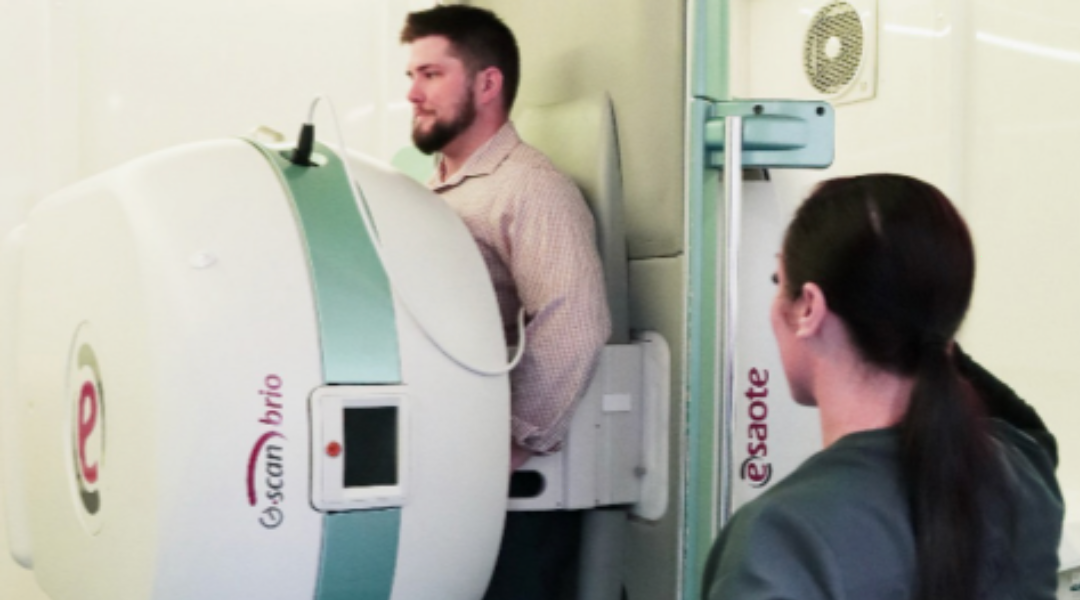
At Barbour Orthopaedics & Spine, we believe that access to advanced imaging should never be a barrier to getting the answers you need. That is why our Main Campus in Atlanta features an on-site, convenient open standing MRI designed with patient comfort as a top priority.
Traditional MRI scanners require patients to lie inside a narrow, enclosed tube, which can be an anxiety-inducing experience for those with claustrophobia, larger body types, or conditions that make lying flat uncomfortable. Our open standing MRI eliminates these barriers. Patients are not enclosed in a tube and can be scanned in natural, weight-bearing positions such as standing or sitting. This open design provides an unobstructed view of the scanning room, significantly reducing anxiety and claustrophobia. Research confirms that patients in open upright MRI report substantially less claustrophobia compared to closed MRI systems, with fewer premature scan terminations and less need for sedation.
Beyond comfort, the weight-bearing capability of a standing MRI offers a meaningful diagnostic advantage. Many spinal and joint problems occur or worsen when the body is upright and under its normal weight, and these issues may not be visible on a traditional lying-down MRI. Our open standing MRI captures images under real-world conditions, helping your provider see exactly what is happening inside your joints in the positions where you actually experience pain.
MRI services are also available at additional Barbour Orthopaedics locations throughout the Atlanta metro area, making advanced orthopedic imaging accessible and streamlined without the long hospital wait times that many patients encounter elsewhere. Because imaging is coordinated directly with your orthopedic team, results are reviewed quickly and your treatment plan can move forward without unnecessary delays.
What to Expect During Your MRI Appointment
Understanding what happens during an MRI appointment can help ease any concerns and ensure a smooth experience. Here is a step-by-step overview of what to expect when you visit Barbour Orthopaedics & Spine for a joint pain MRI.
Before Your Scan: You will be asked to wear comfortable clothing without metal fasteners or accessories. In some cases, you may change into a gown. Your technologist will review your medical history and ask about any metal implants, devices, or conditions that may affect MRI safety. Be sure to inform the team about any prior surgeries, pacemakers, or metal hardware in your body.
During Your Scan: You will be positioned comfortably in the MRI scanner, and the technologist will communicate with you throughout the process. With our open standing MRI, you will not be enclosed in a tube. Depending on the area being scanned, you may be standing, sitting, or in another comfortable position. Each scan sequence typically takes about 90 seconds, and the total appointment generally lasts between 20 and 60 minutes depending on the area being evaluated. You will need to remain as still as possible during scanning to ensure the clearest possible images.
After Your Scan: Your images will be reviewed by a qualified radiologist and shared with your Barbour Orthopaedics orthopedic specialist, who will discuss the findings with you and explain what they mean for your treatment plan. In most cases, results are available quickly, allowing your care team to move forward with targeted recommendations without prolonged waiting.
How MRI Results Guide Your Treatment Plan
The true value of a joint pain MRI lies not just in the images it produces, but in the treatment decisions those images make possible. Once your orthopedic specialist reviews your MRI results, they can develop a clear, personalized treatment plan tailored to the specific condition revealed by the scan.
Physical Therapy
If your MRI reveals mild to moderate degenerative changes, a stable meniscal tear, mild tendinitis, or early cartilage wear, your provider may recommend a targeted physical therapy program. MRI findings help your therapist design exercises that address the exact structures involved, rather than using a generic approach. This specificity leads to faster improvement and better outcomes. Learn more about non-surgical orthopedic treatment options that may be part of your recovery plan.
Injection Therapies
For conditions such as moderate arthritis, bursitis, or persistent tendon inflammation, your MRI results can guide the use of corticosteroid injections, hyaluronic acid (viscosupplementation), or other injectable treatments. Imaging ensures that injections are targeted to the precise location of the problem, maximizing their effectiveness. Ultrasound guidance can also be used to further improve injection accuracy.
Regenerative Medicine
Platelet-rich plasma (PRP) therapy and other regenerative treatments are increasingly used for chronic tendon injuries, early arthritis, and certain cartilage conditions. MRI findings help determine whether you are a good candidate for these advanced therapies by showing the extent and nature of tissue damage. Patients with partial tendon tears or early cartilage degeneration, for example, may benefit significantly from regenerative approaches when identified early through orthopedic imaging.
Surgical Intervention
When MRI reveals conditions that are unlikely to resolve with conservative care, such as complete ligament ruptures, large meniscal tears with mechanical symptoms, significant labral tears, or advanced joint destruction, your orthopedic surgeon can plan the most appropriate surgical approach with confidence. Detailed MRI provides a clear roadmap, helping surgeons plan effective procedures and set realistic expectations for recovery.
Why Early Evaluation for Chronic Joint Pain Improves Outcomes
The evidence is clear: the sooner chronic joint pain is properly evaluated and diagnosed, the better the outcomes. Early detection of conditions like arthritis allows patients to implement evidence-based treatment strategies to manage pain, improve joint function, and potentially slow disease progression. For inflammatory conditions like rheumatoid arthritis, early diagnosis leads to earlier treatment initiation, which directly improves long-term outcomes and helps prevent irreversible joint damage.
Patients who receive timely orthopedic imaging benefit from shorter recovery times, less invasive treatments, better long-term joint function, and reduced risk of chronic disability. Rather than enduring months of trial-and-error treatment based on incomplete information, early imaging gives you and your provider the clarity needed to take decisive, effective action.
At Barbour Orthopaedics & Spine, we encourage patients not to ignore joint pain that has been present for more than a few weeks. Whether your symptoms stem from an old injury, repetitive overuse, or age-related changes, the first step toward relief is a thorough evaluation with an experienced orthopaedic specialist who can determine whether advanced imaging is the next step in your care.
Take the Next Step Toward Answers and Relief
Living with chronic joint pain is not something you have to accept. When pain persists, a joint pain MRI or other advanced orthopedic imaging study can uncover the true cause of your discomfort and open the door to effective, targeted treatment. At Barbour Orthopaedics & Spine, our team is ready to evaluate your condition, provide on-site advanced imaging at our Main Campus and additional locations, and develop a personalized treatment plan so you can move forward with confidence.
Do not wait for chronic joint pain to limit your life further. Contact Barbour Orthopaedics & Spine today to schedule your comprehensive evaluation. With our convenient open standing MRI, expert orthopedic specialists, and commitment to patient-centered care, we are here to give you the answers you deserve and the relief you need.
Follow us on our social media!
