
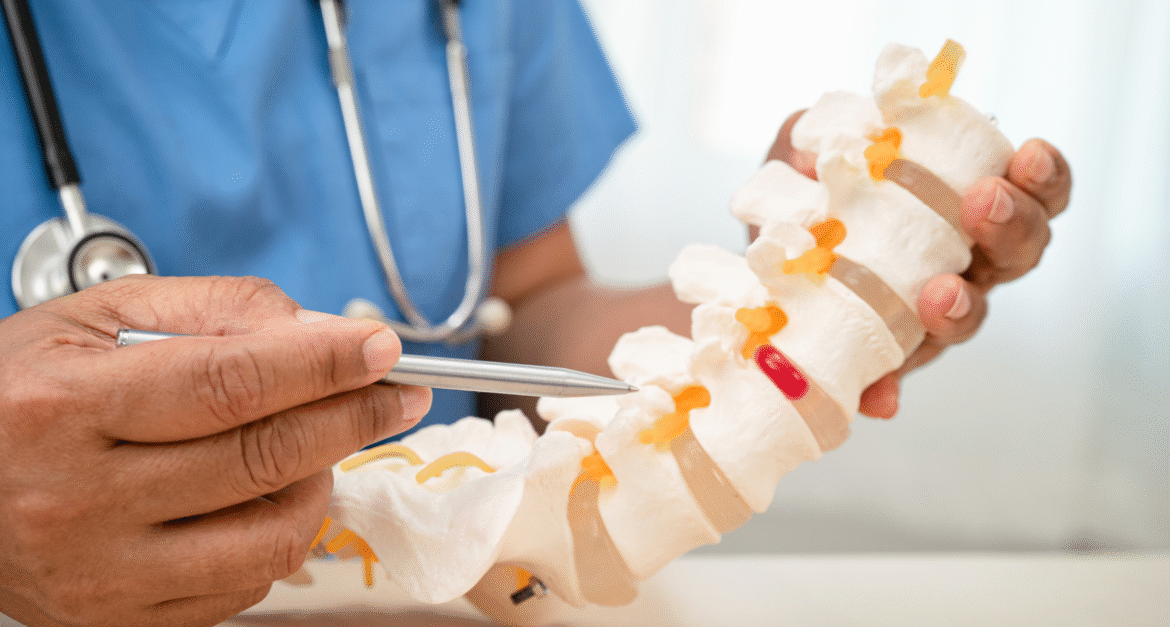
A herniated disk can transform daily routines into agonizing tasks for millions of people each year. At Barbour Orthopaedics & Spine, we understand each patient’s encounter with disc herniation is unique, requiring individualized approaches to care from conservative treatment to advanced surgery. Across our complete herniated disc treatment philosophy, each patient is administered the most suitable care for his or her specific affliction, so they might lead fully productive lives again.
Understanding Herniated Discs
A herniated, ruptured, or slipped disc refers to a condition where the soft, jellylike center of a spinal disc pushes through a tear in the harder, outer ring. It can push against surrounding nerves, producing a feeling of pain, numbness, tingling, and weakness, often radiating from your back through parts of your body.
The spine contains 23 intervertebral discs acting as shock absorbers and cushioning between the vertebrae, facilitating flexibility in movement. Since the discs are weakened through stress, trauma, or age, the resulting herniation may affect everyday function in a marked way.
Common Symptoms by Location
Cervical spine (neck) herniations cause shooting pain into the shoulder, arm, and hand, numbness or tingling in the fingers, and potential arm weakness.
Lumbar spine (lower back) herniations most commonly produce pain radiating in one or both legs (sciatica), numbness, tingling, or weakness in a leg or foot.
Thoracic spine (mid-back) herniations are less frequent but can generate chest pain or pain embracing the trunk.
Causes and Risk Factors
Knowing the causes of herniation informs patient decisions on prevention and treatment options.
Age-related degeneration is the most common cause, as discs in normal use lose elasticity and water content with age. Traumatic injury from falls or unexpected lifting can generate an instantaneous herniation, particularly with poor technique.
Occupational factors include prolonged sitting, recurrent bending and lifting, exposure to vibration, and heavy work. Lifestyle factors such as being overweight, lack of physical activity, smoking, and poor body posture are also dangerous contributors to disc herniation.
Comprehensive Diagnostic Approach
Accurate diagnosis is key in determining the best treatment for slipped disc cases. At Barbour Orthopaedics & Spine, our diagnostic process begins with close clinical evaluation.
Our specialists carry out thorough physical examinations and medical histories, including neurological testing to assess reflexes, muscle power, and sensibility, as well as particular orthopedic examinations.
Advanced imaging in our practice includes MRI for superior soft tissue detail, CT evaluation for examination of bony structures, X-rays for ruling out fractures and determining alignment, and diagnostic injections for confirmation of pain generators with therapeutic effect.
Conservative Herniated Disc Treatment Options
Most patients recover well from conservative treatment without surgical involvement. Our holistic approach addresses pain relief, decreasing inflammation, and functional restoration.
Pain Management and Medication
NSAIDs like ibuprofen or naproxen are useful in relieving pain and inflammation on a daily basis as necessary. Muscle relaxants relieve spasm, a frequent associate with disc herniation. Neuropathic medication like gabapentin specifically addresses nerve pain characteristic of a disc herniation. Short-term oral steroids may be administered for severe inflammation and acute attacks.
Physical Therapy and Rehabilitation
Professional physical therapy forms the cornerstone of conservative disc herniation options. Physical therapy experts from our practice develop tailored therapies for decreasing pain, improving motion, and regaining functionality.
Initial phase therapy includes pain management and movement for range of motion exercises. Progressive strengthening targets back extensor and core muscle strength for added spinal stability. Postural training addresses movement pattern deficiencies, teaching people proper body mechanics. Manual therapy restores normal spinal movement and reduces muscle tightness.
Activity Modification
Activity restrictions for a period assist in decreasing disc stress and facilitating healing. This includes avoiding heavy lifting, prolonged standing or sitting, and activities causing pain. Ergonomic evaluation identifies occupational factors contributing to disc issues, with suggestions for setting up a workstation and correct techniques.
Advanced Non-Surgical Interventions
If conservative therapies offer insufficient relief, a wide array of advanced non-surgical therapies can effectively treat symptoms.
Epidural Steroid Injections
These locally applied site-specific injections deliver anti-inflammatory medications directly where they are needed, thereby delivering relief from pain for the majority of patients. Efficacy for qualified patients ranges from 70-90%, and relief duration is typically 3-6 months. The procedure involves fluoroscopy-guided needle placement to achieve pinpoint medication administration.
Additional Injection Therapies
Selective nerve root blocks target isolated nerve roots implicated in disc herniation for therapeutic benefit as well as diagnosis. Facet joint injections provide pain relief when joint inflammation accompanies a disc herniation. Radiofrequency ablation provides prolonged relief for chronic pain through the disruption of pain signal transmission.
Surgical Treatment Options
If conservative therapy fails within 6-12 weeks or if the patient starts to develop progressive neurological symptoms, surgery may be recommended.
Microdiscectomy
This procedure remains the gold standard for surgical herniated disc treatment. It is a minimally invasive procedure where the surgeon clears up herniated disc material compressing against the nerves with preservation of healthy disc material through a small incision. Success rates exceed 90% in favorable cases, with most patients experiencing significant relief from pain within days to weeks. Recovery typically allows return to desk-type activity in 2-4 weeks and normal activity in 6-12 weeks.
Advanced Surgical Options
Endoscopic disc surgery utilizes ultra-minimally invasive techniques with smaller incisions and potentially shortened recovery times. Artificial disc replacement maintains spinal movement in carefully selected patients where a single-level herniation exists and limited degenerative change is present. Spinal fusion remains the treatment option for significant instability or multi-level disease.
Creating Your Treatment Plan
The best treatment for slipped disc cases depends on a combination of factors that our specialists examine in detail.
Initial conservative phase (6-12 weeks) entails medication, physical therapy, activity modification, and ergonomic optimization for facilitating natural recovery in addition to treating causative factors.
The advanced conservative phase (3-6 months) may include epidural steroid injections, sophisticated therapy plans, and multimodal pain relief approaches for persistent symptoms.
Surgical consideration is made when conservative therapies are not yielding sufficient relief, progressive neurological signs emerge, or marked functional limitations are present.
Why Choose Barbour Orthopaedics & Spine
Comprehensive Expertise
Our board-certified spine experts are well-experienced in the treatment of all forms of disc herniation, ranging from conservative care to complex surgical procedures.
Advanced Technology
State-of-the-art imaging, including open and traditional MRI, fluoroscopy-guided injection facilities, and the latest surgical equipment, ensures accurate diagnosis and effective treatment.
Multidisciplinary Approach
Smooth coordination between your spine doctors, pain specialists, physical therapists, and surgical teams provides streamlined care coordination throughout your entire course of treatment.
Patient-Centered Care
Treatment plans are individually developed for your specific problem, daily needs, and personal objectives, with ongoing education and support throughout recovery.
Prevention and Long-Term Health
While not all disc herniations can be avoided, many approaches reduce risk and enhance spinal well-being. Exercise regularly with emphasis on core strengthening, use proper lifting techniques, attain and retain a healthy weight, avoid prolonged sitting, and sleep on supportive mattresses.
Take Control of Your Disc Herniation Today
Herniated discs don’t have to take over your life. With accurate diagnosis, proper selection of treatment, and skilled care, most patients can experience significant pain relief and get back to their desired activity levels.
At Barbour Orthopaedics & Spine, we are committed to delivering the whole spectrum of disc herniation options, from conservative care to the most advanced surgical interventions. Our five-star-rated facilities throughout Georgia and South Carolina offer convenient access to comprehensive spine care with the personalized attention you deserve.
Whether your case requires conservative care or surgery, our experienced staff will guide you through every step in the treatment process, providing the most effective care for your specific situation.
Follow us on our social media!
